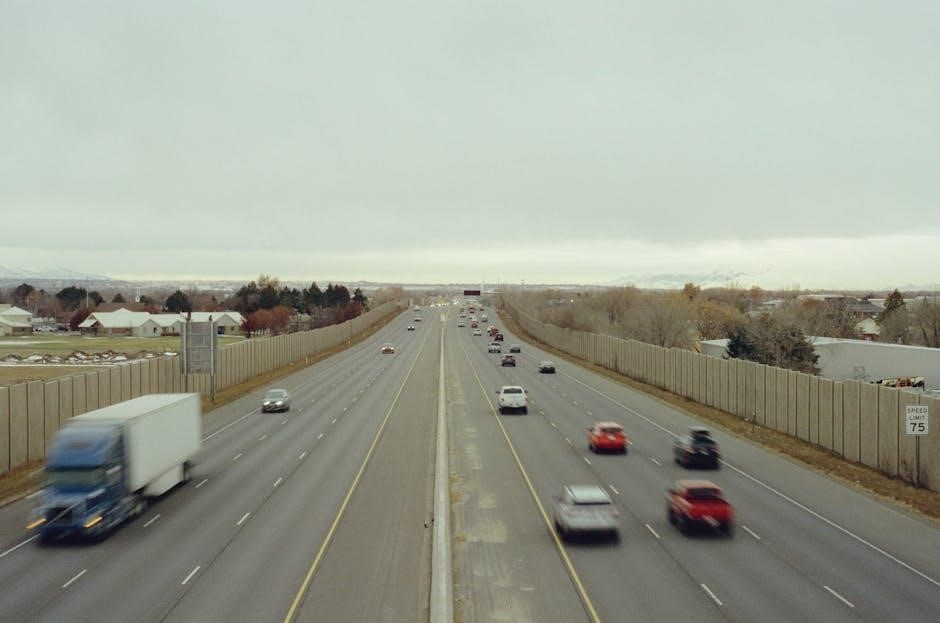
Highway and Expressway Guide Signs: A Comprehensive Guide
Highway and expressway guide signs are crucial for driver navigation, primarily utilizing green backgrounds with white lettering for clear visibility and consistent messaging.
Highway and expressway guide signs represent a vital component of safe and efficient roadway travel, offering directional and informational assistance to motorists. These signs are strategically positioned to provide advance notice of upcoming exits, destinations, and route changes.
Unlike regulatory or warning signs, guide signs focus on guiding drivers, employing a consistent visual language to minimize confusion. They are primarily identified by the name of the sign, rather than a specific designation number, as outlined in the MUTCD.
Effective guide signing relies on standardized design elements – letter styles, heights, and arrow usage – ensuring uniformity across different jurisdictions. This standardization, detailed in publications like the FHWA’s Standard Highway Signs, is paramount for driver comprehension and reduced reaction times.
Color Coding and General Principles
Highway and expressway guide signs adhere to a strict color-coding system to convey information efficiently. The predominant color scheme is green with white lettering, universally recognized as indicating guidance towards destinations and routes. This contrasts sharply with regulatory (red/white) and warning (yellow/black) signs.
Uniformity in design is a cornerstone principle. Standardized letter styles, heights, and arrow designs, as detailed in the Standard Highway Signs publication, ensure consistent readability and comprehension across vast distances and varying conditions.

This consistency minimizes cognitive load on drivers, allowing them to process information quickly and react appropriately. The MUTCD emphasizes this principle, promoting a predictable visual environment for all road users.
Green with White Letters: The Standard
Highway and expressway guide signs overwhelmingly employ a green background with white lettering as the definitive standard. This color combination isn’t arbitrary; it’s strategically chosen for optimal visibility under diverse weather and lighting conditions. The high contrast enhances legibility, particularly at highway speeds.
This standard isn’t merely a convention but a foundational element of traffic control, as outlined by the MUTCD and FHWA guidelines. It signifies directional information, guiding drivers to destinations, interchanges, and route markers.
The consistent use of green and white fosters driver expectation and reduces confusion, contributing significantly to road safety and efficient traffic flow.
Importance of Uniformity in Design
Highway and expressway guide signs demand strict uniformity in design for several critical reasons. Standardized letter styles, heights, and arrow designs, as detailed in the Standard Highway Signs publication, ensure drivers nationwide interpret information identically. This consistency minimizes cognitive load and reaction times, enhancing safety.
Variations in sign design can lead to confusion, potentially causing missed exits or incorrect maneuvers. The MUTCD emphasizes this, advocating for a predictable visual environment. Recommended letter spacing, also standardized, further contributes to readability.

Uniformity isn’t just aesthetic; it’s a core principle of effective traffic control, fostering driver trust and reducing the risk of accidents;
Types of Guide Signs

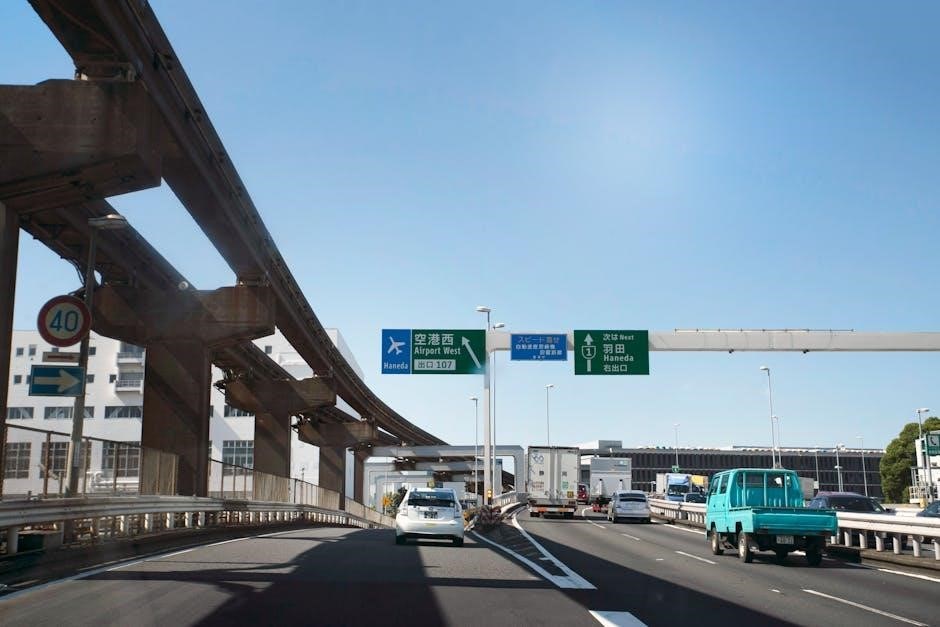
Highway and expressway guide signs encompass several distinct categories, each serving a specific purpose. Destination signs provide directional guidance to cities, towns, and points of interest. Route marker signs identify specific highway or expressway routes, utilizing standardized shapes and colors. These are crucial for long-distance travel.
Interchange signs are particularly complex, offering advance warning and directional information for upcoming interchanges, including exit numbers and lane assignments. Diagrammatic guide signs, used for option lanes, visually depict lane usage.
These sign types work in concert to create a comprehensive guidance system, ensuring drivers can navigate efficiently and safely.
Destination Signs
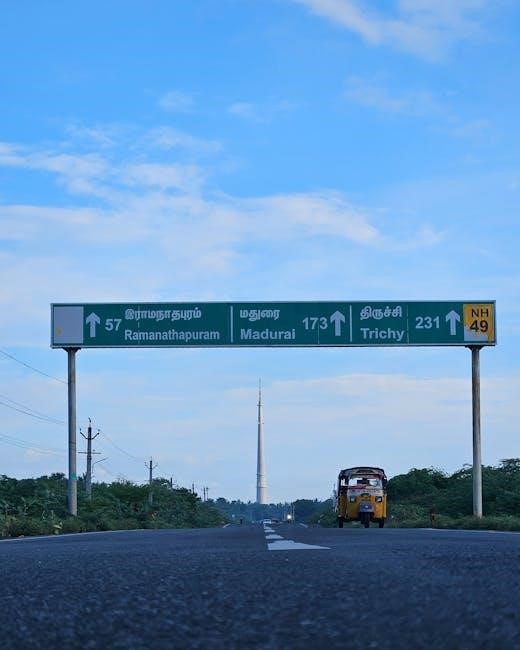
Destination signs on highways and expressways are fundamental for guiding travelers to their intended locations. These signs prominently display the names of cities, towns, and significant points of interest, often accompanied by directional arrows and distances. They are typically green with white lettering, adhering to standardized design principles for optimal readability.
Effective destination signage provides advance notice of upcoming destinations, allowing drivers ample time to prepare for lane changes or exits. The clarity and consistency of these signs are paramount for reducing driver confusion and enhancing safety. They are a core component of the overall guide sign system.
Route Marker Signs
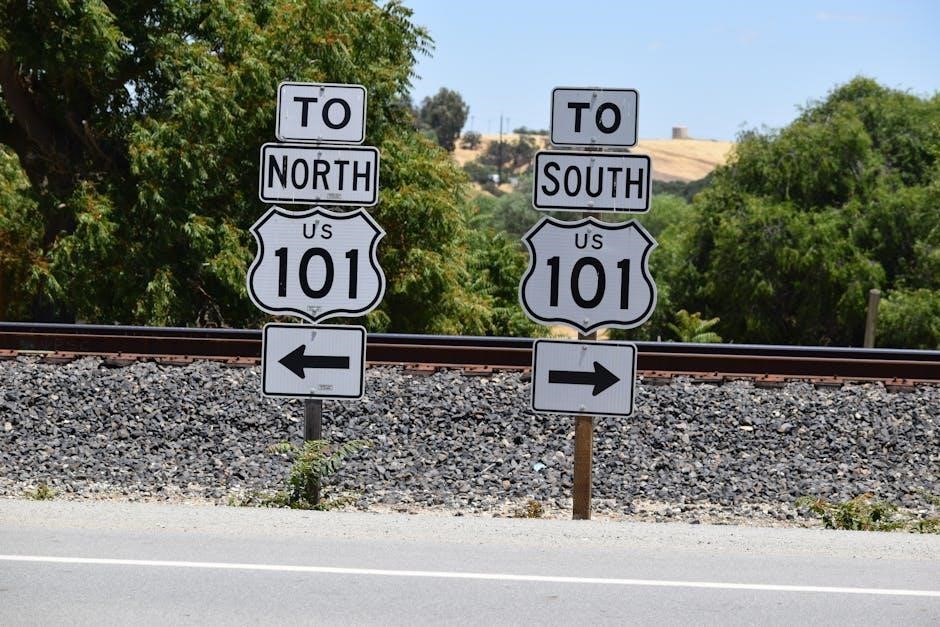
Route marker signs are essential components of highway and expressway guide systems, clearly identifying numbered routes for motorists. These signs utilize distinctive shapes and colors to denote different types of roadways – interstates, U.S. routes, and state routes – ensuring quick recognition. Typically, these signs feature the route number in white or black against a colored background, varying based on route type.

Standardization in route marker sign design is critical for uniformity across states and regions. This consistency minimizes driver confusion and facilitates seamless navigation. Proper placement and visibility of these signs are also vital for effective route guidance, contributing significantly to overall highway safety.
Interchange Signs
Interchange signs are a vital part of highway and expressway guidance, providing crucial information to drivers navigating complex junctions. These signs often employ diagrammatic representations of the interchange layout, illustrating lane configurations and exit options. They are strategically placed in advance of the interchange to allow drivers ample time to prepare for upcoming maneuvers.
Effective interchange signage includes clear destination information, exit numbers, and directional arrows. The MUTCD and FHWA guidelines emphasize the importance of simplicity and legibility in these designs. Supplementing standard signs with advisory panels, like exit speed recommendations (E13-2 panels), further enhances driver safety and reduces confusion at these critical decision points.
Design Elements of Guide Signs
Highway and expressway guide signs rely on standardized design elements to ensure clarity and uniformity. Letter style and height are meticulously regulated, with tables of recommended letter spacing available in the Standard Highway Signs publication. This standardization assures effective application across diverse locations.
Arrow design is also crucial, guiding drivers with unambiguous directional cues. Consistent arrow shapes and sizes contribute to quick comprehension. Furthermore, careful consideration is given to letter spacing, optimizing readability at highway speeds. These elements, combined with the established color coding, create a cohesive system that minimizes driver confusion and promotes safer travel on freeways and expressways.
Letter Style and Height Standardization
Highway and expressway guide signs benefit significantly from letter style and height standardization, a practice implemented to guarantee uniform and effective application. Designs for both upper and lower-case alphabets are precisely defined, ensuring consistency across all signage. This standardization isn’t arbitrary; it’s based on research into optimal readability at typical highway speeds.
Specific tables detailing recommended letter spacing are also provided within the Standard Highway Signs publication. These guidelines dictate the precise distance between characters, maximizing legibility for drivers. By adhering to these standards, transportation agencies ensure that information conveyed on guide signs is easily and quickly understood, contributing to enhanced safety and efficient traffic flow.
Arrow Design and Usage
Highway and expressway guide signs employ standardized arrow designs to clearly indicate direction and movement. These arrows aren’t simply aesthetic choices; their shape, size, and angle are carefully regulated to maximize comprehension at highway speeds. Consistent arrow usage minimizes driver confusion and promotes intuitive navigation.
The precise specifications for arrow design are detailed within the Standard Highway Signs publication, ensuring uniformity across different jurisdictions. Arrows are strategically used in conjunction with text to reinforce directional information, particularly at interchanges and exits. Proper arrow placement and size are critical for conveying intended routes effectively, contributing to safer and more efficient travel on freeways and expressways.
Recommended Letter Spacing
Highway and expressway guide signs necessitate precise letter spacing for optimal readability at highway speeds. The Standard Highway Signs publication provides detailed tables outlining recommended spacing based on letter style and height. This standardization ensures legibility, even for drivers with varying visual acuity or under challenging weather conditions.
Insufficient spacing can cause letters to blur together, while excessive spacing diminishes comprehension. Careful attention to these guidelines is paramount for effective communication. Consistent letter spacing across all signs contributes to a uniform visual experience, enhancing driver confidence and reducing cognitive load. Adhering to these recommendations is a key element of safe and efficient highway design.
Specific Sign Applications
Highway and expressway guide signs demonstrate versatility in specific scenarios, notably option lanes and exit speed advisories. Diagrammatic guide signs are employed to clearly illustrate lane choices, aiding drivers in navigating complex interchanges. For situations demanding heightened attention to reduced ramp speeds, an “EXIT XX MPH” (E13-2) panel supplements standard exit signage, but doesn’t replace existing speed warnings.
These supplemental panels emphasize potentially hazardous speed reductions. Proper application of these signs, guided by the MUTCD and FHWA standards, is crucial for preventing accidents. Consistent and strategic placement ensures drivers receive timely and understandable information, promoting safer merging and exiting maneuvers on freeways and expressways.
Guide Signs for Option Lanes

Highway and expressway guide signs play a vital role in directing drivers through option lanes, particularly at complex interchanges. These signs utilize diagrammatic representations to clearly illustrate lane usage, showing which lanes lead to specific destinations or routes. This visual guidance is essential for reducing confusion and promoting smooth traffic flow.
Detailed designs for these signs are found within the Standard Highway Signs and Markings book. Effective option lane signage minimizes last-minute lane changes, a significant contributor to accidents. The goal is to provide drivers with sufficient advance notice and understandable information, enabling them to select the correct lane well before reaching the decision point.
Exit Speed Advisory Signs (E13-2 Panels)
Highway and expressway guide signs sometimes require supplemental warnings regarding exit ramp speeds. The E13-2 panel, displaying “EXIT XX MPH,” is used to emphasize particularly low advisory speeds on exit ramps. This panel is strategically placed below the destination legend on guide signs, providing an additional layer of caution for drivers.
Crucially, the E13-2 panel supplements existing exit or ramp advisory speed warning signs; it does not replace them. This approach ensures drivers receive multiple reminders to reduce speed appropriately before navigating the exit ramp. Utilizing these panels enhances safety by proactively alerting drivers to potentially hazardous speed reductions.
Regulatory Standards and Guidelines
Highway and expressway guide signs are governed by strict regulatory standards to ensure uniformity and safety. The Manual on Uniform Traffic Control Devices (MUTCD) serves as the primary national standard, detailing specifications for design and placement. Further guidance is found in the FHWA’s Standard Highway Signs publication, referenced within the MUTCD and Engineering Policy Guides (EPG 911).
In specific contexts, like India, the IRC 67/IRC SP 99 Guidelines dictate sign design. These standards cover aspects like letter style, height, and spacing, ensuring consistent application. Adherence to these guidelines is paramount for maximizing driver comprehension and minimizing confusion across different jurisdictions.
MUTCD (Manual on Uniform Traffic Control Devices)
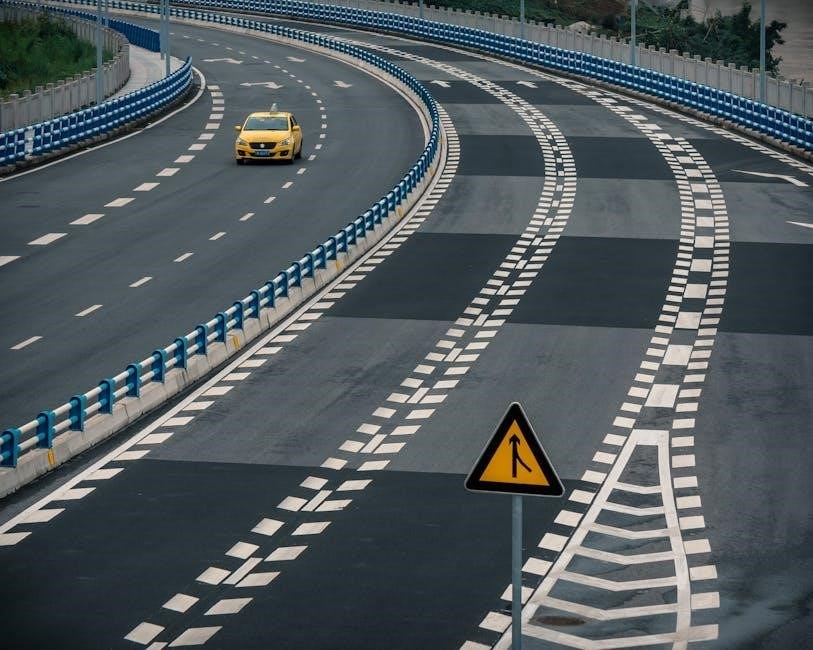
Highway and expressway guide signs are comprehensively addressed within the MUTCD, specifically Chapter 2E, focusing on freeways and expressways. The MUTCD doesn’t assign specific sign designations based on name; instead, it categorizes them by function. It provides detailed guidelines for design, referencing the FHWA’s Standard Highway Signs publication (Section 1A.05) for further specifications.
The MUTCD dictates requirements for legibility, reflectivity, and placement, ensuring signs are easily visible and understandable. It emphasizes consistent application of standards to promote nationwide uniformity, enhancing driver safety and reducing potential for misinterpretation. Compliance with the MUTCD is legally mandated for most public roadways.
FHWA’s Standard Highway Signs Publication
Highway and expressway guide signs receive detailed design specifications within the FHWA’s Standard Highway Signs publication, serving as a crucial supplement to the MUTCD. This publication provides comprehensive details on letter styles, heights, and recommended spacing, ensuring uniformity and effectiveness across the national highway system.
It includes tables for both upper and lowercase alphabets, aiding in consistent sign creation. Furthermore, the publication details designs for arrow usage, vital for directional clarity. Specific guidance for freeway and expressway diagrammatic signs, including option lane configurations, is also contained within its pages, referencing Section 1A.11 for more detailed information.
IRC 67/IRC SP 99 Guidelines (Indian Context)
Highway and expressway guide signs within the Indian context are governed by IRC 67 and IRC SP 99 guidelines, establishing standards for their design and implementation. These guidelines dictate that all signs must adhere to the specifications outlined within these documents, ensuring consistency and clarity for drivers across the nation’s roadways.
The guidelines cover crucial aspects such as font selection and overall sign design, promoting uniformity. They are essential for maintaining road safety and efficient traffic flow. Adherence to IRC 67/IRC SP 99 is mandatory for all sign construction and installation projects, guaranteeing a standardized approach to guide sign provision.
Advanced Features and Considerations
Highway and expressway guide signs are evolving with advanced features to enhance driver understanding. Diagrammatic guide signs are increasingly utilized, offering visual representations of lane configurations and upcoming exits, improving comprehension at a glance. These signs are particularly helpful in complex interchanges.
Furthermore, emphasis on low advisory ramp speeds is gaining traction. Utilizing “EXIT XX MPH” panels (E13-2) below destination legends supplements standard advisory speed warnings, drawing attention to potentially hazardous curves or merges. This doesn’t replace existing warnings but adds crucial reinforcement, prioritizing driver safety and smoother traffic flow.
Diagrammatic Guide Signs
Highway and expressway guide signs increasingly incorporate diagrammatic elements to improve driver comprehension, especially within complex interchanges. These signs move beyond simple text, visually representing lane usage and exit configurations. They offer a quick, intuitive understanding of the road ahead, reducing reaction times and enhancing safety.
Designs for these signs are detailed within the Standard Highway Signs and Markings book, ensuring consistency and clarity. The goal is to provide a readily interpretable visual cue, supplementing traditional text-based guidance. This approach is particularly effective for option lanes and complicated merging scenarios, aiding drivers in making informed decisions.
Low Advisory Ramp Speed Emphasis
Highway and expressway guide signs sometimes require extra emphasis on particularly low advisory ramp speeds to proactively alert drivers. To achieve this, an “EXIT XX MPH” (E13-2) panel is often placed directly below the destination legend on the guide sign.
This supplemental panel doesn’t replace standard exit or ramp advisory speed warning signs; instead, it reinforces the information, drawing attention to potentially hazardous curves or merges. This layered approach to speed communication is vital for safety, especially when ramp speeds deviate significantly from freeway speeds. Careful consideration of placement and visibility is paramount for effective implementation.